About this guide: Written by the local SEO team at Harmukh Technologies, based on Google Business Profile audits and optimisation campaigns for law firms across the US and UK. Data reflects live GBP performance tracking across personal injury, family law, and criminal defense practice areas.
Published: March 2026 · Reading time: 11 minutes

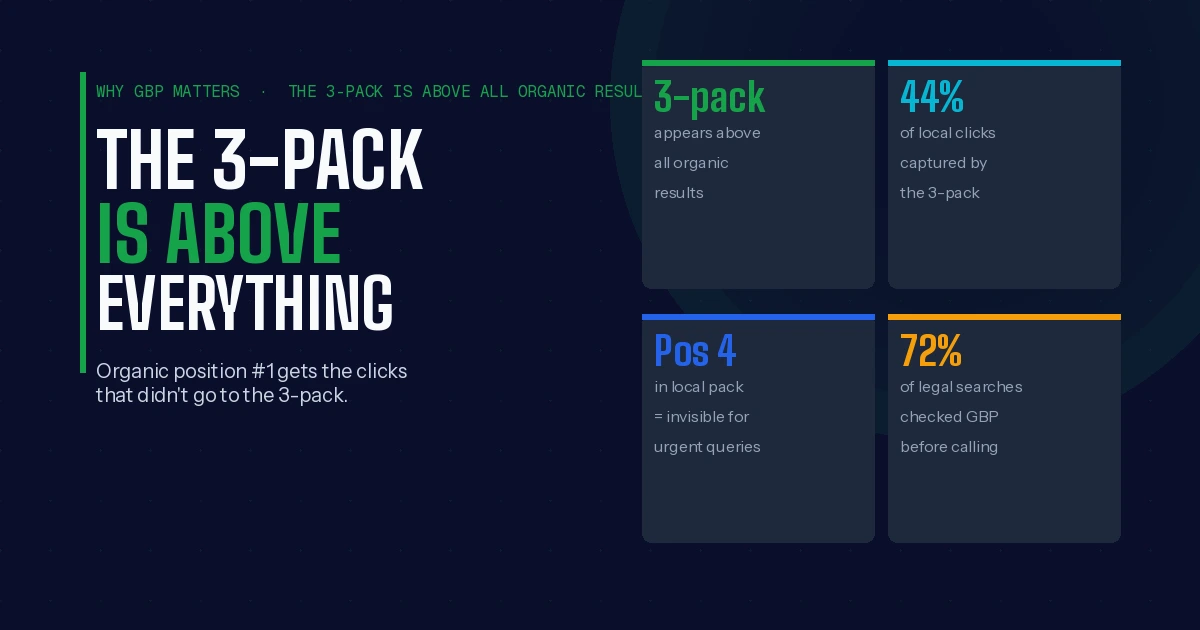
The Google local 3-pack appears above every organic search result for local legal queries. A law firm that wins a 3-pack position is one of three firms shown before a single organic listing is visible. A firm that doesn’t is competing for the scraps of attention that remain after users have already seen three options and a phone number to call.
Google Business Profile is the mechanism that determines 3-pack eligibility. And yet most law firms treat GBP as a set-it-and-forget-it directory listing — filled in at launch, never touched again. The result: a firm with excellent organic SEO and a neglected GBP profile that consistently loses to competitors with mediocre websites and well-maintained GBP profiles, because local pack position is decided by GBP signals, not organic ranking signals.
This guide covers every element of GBP optimisation for law firms: category selection, review velocity, NAP citation consistency, post and Q&A activity signals, multi-location management, and the audit checklist that identifies every suppressible issue in an existing GBP profile.
What This Guide Covers
- Why GBP determines the highest-value real estate in legal search
- Category selection: the highest-leverage single GBP change
- Building a review system that produces consistent velocity
- NAP consistency and legal directory citations
- GBP posts and Q&A: the activity signals Google weighs
- Multi-location law firms: one GBP per office
- The GBP audit checklist for law firms
- Frequently asked questions about GBP for law firms
Why GBP Determines the Highest-Value Real Estate in Legal Search
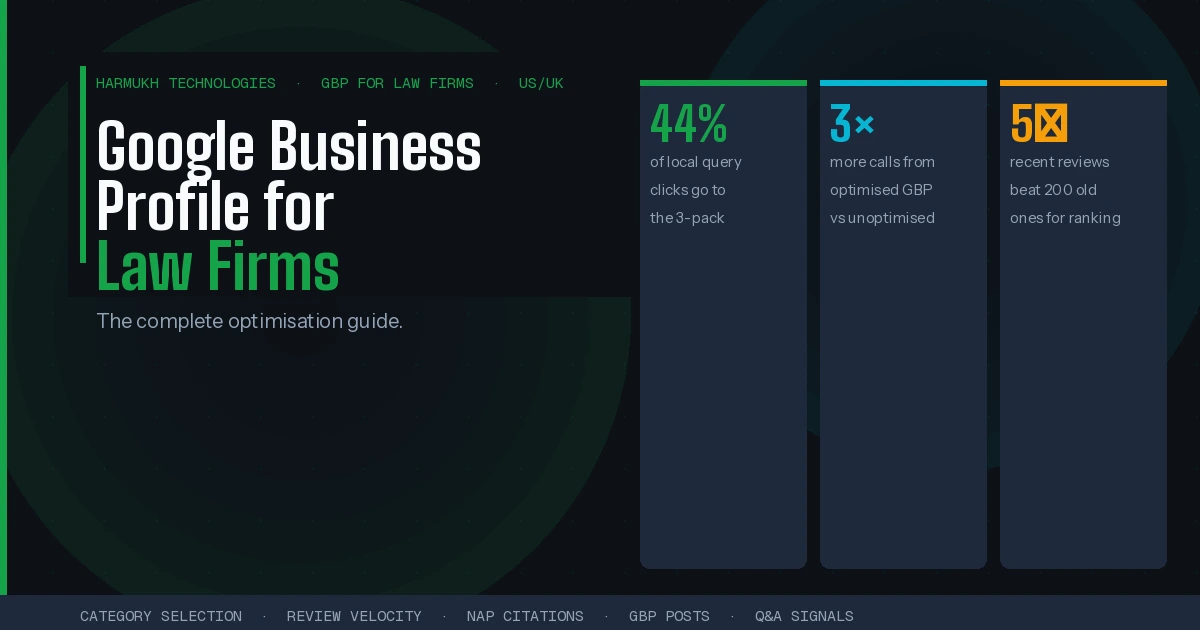
The Google local 3-pack captures approximately 44% of all clicks on local search queries — more than any single organic position, including position #1. For personal injury, criminal defense, and family law queries specifically, the 3-pack captures the majority of phone calls, because emergency-intent and research-intent legal users frequently call directly from the GBP listing without visiting the website. A firm that consistently holds a 3-pack position is not just ranking well — it is receiving a category of high-intent leads that its organic-only competitors never see.
What GBP signals Google actually measures
Google’s local ranking algorithm evaluates three broad signal categories for 3-pack eligibility: relevance (does the GBP profile match the user’s search intent), distance (is the business physically close to the user or their specified location), and prominence (how well-established and active is the business online). Of these three, relevance and prominence are the signals that law firms can actively optimise. Distance is fixed. Relevance is controlled primarily by category selection and keyword usage in the GBP description. Prominence is driven by review velocity, citation consistency, and activity signals from posts and Q&A.
The gap most law firms leave open
In competitive legal markets — personal injury in New York, criminal defense in Los Angeles, family law in London — the difference between the firm in 3-pack position 3 and the firm in position 4 (invisible) is often not organic authority. It is GBP optimisation. The firm in position 3 has the right primary category, posts consistently, maintains review velocity, and has clean NAP citations. The firm in position 4 has the category set to “Law Firm,” hasn’t posted in four months, has 80 reviews from three years ago, and has three citation inconsistencies across its legal directory profiles. Fixing those four issues — none of which requires content production or backlink acquisition — will typically move a firm from position 4 to position 2 in 60–90 days in most markets.
For the broader context of how GBP fits within a complete law firm SEO strategy, our law firm SEO guide covers the full ecosystem from local pack to organic rankings to GEO citations.
Category Selection: The Highest-Leverage Single GBP Change
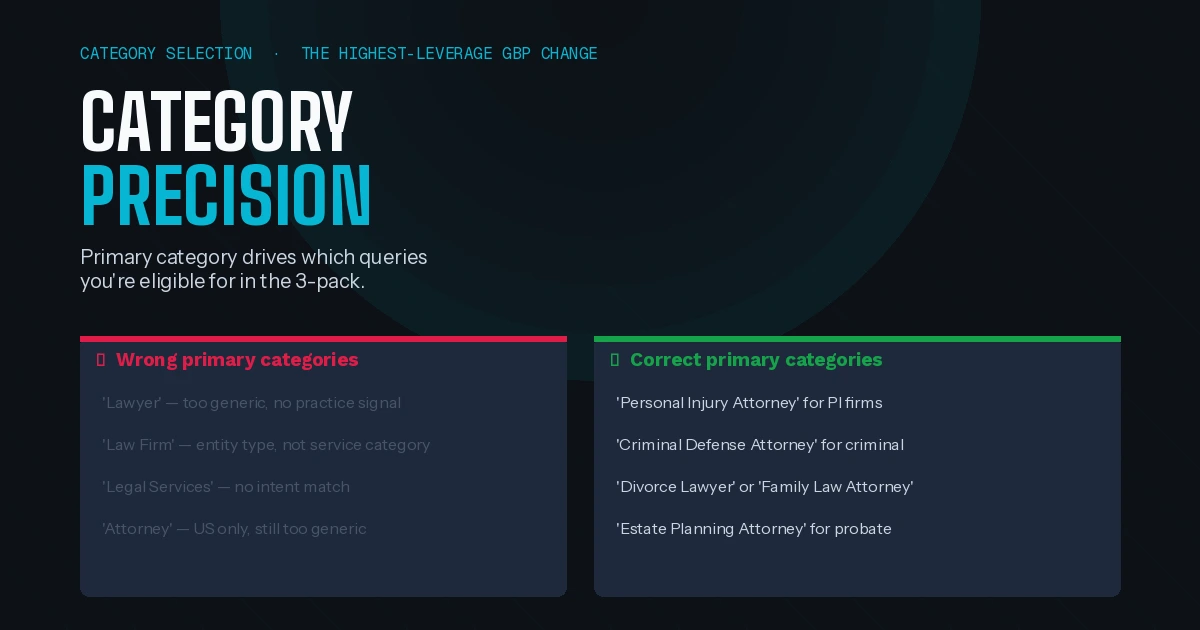
Your GBP primary category is the single most impactful element in your 3-pack eligibility for specific practice area queries. Google’s local algorithm uses primary category as the primary relevance signal — it determines which searches your profile is considered for before any other signals are evaluated. Setting the wrong primary category means you’re invisible for your highest-value queries regardless of how well every other GBP element is optimised.
The correct primary category for each practice type
Personal injury firms: “Personal Injury Attorney” — not “Lawyer,” not “Law Firm,” not “Legal Services.” The specificity of “Personal Injury Attorney” directly matches the specificity of queries like “personal injury attorney Chicago,” and Google matches them accordingly. A profile with primary category “Lawyer” will consistently rank below a profile with “Personal Injury Attorney” for PI-specific queries, even if the “Lawyer” profile has more reviews and stronger organic authority.
Criminal defense firms: “Criminal Justice Attorney” or “Criminal Defense Attorney” depending on what appears in Google’s category autocomplete for your market. Check what category your top 3-pack competitors are using for your primary target query — that’s the category that Google has validated as matching the intent for your market.
Family law firms: “Divorce Lawyer” or “Family Law Attorney” — the choice depends on whether the majority of your cases are divorce-related (use “Divorce Lawyer,” which matches higher query volume) or cover broader family law (use “Family Law Attorney”). Avoid “Domestic Relations Attorney” — it’s technically accurate but has lower query-match frequency.
Estate planning and probate: “Estate Planning Attorney” — this is a well-established Google category with strong query match for estate and probate searches. Do not use “Attorney” or “Lawyer” as the primary category for a specialist practice.
Secondary categories: expand without diluting
Add secondary categories for every practice area you actively serve — these expand the range of queries your profile is eligible for without diluting the primary category signal. A personal injury firm that also handles workers’ compensation should add “Workers Compensation Attorney” as a secondary category. A family law firm that handles adoptions should add “Adoption Attorney.” The limit is what you actually practice — adding categories for areas you don’t handle creates a category-to-content mismatch that Google can detect and that will suppress rather than expand your 3-pack eligibility.
Building a Review System That Produces Consistent Velocity
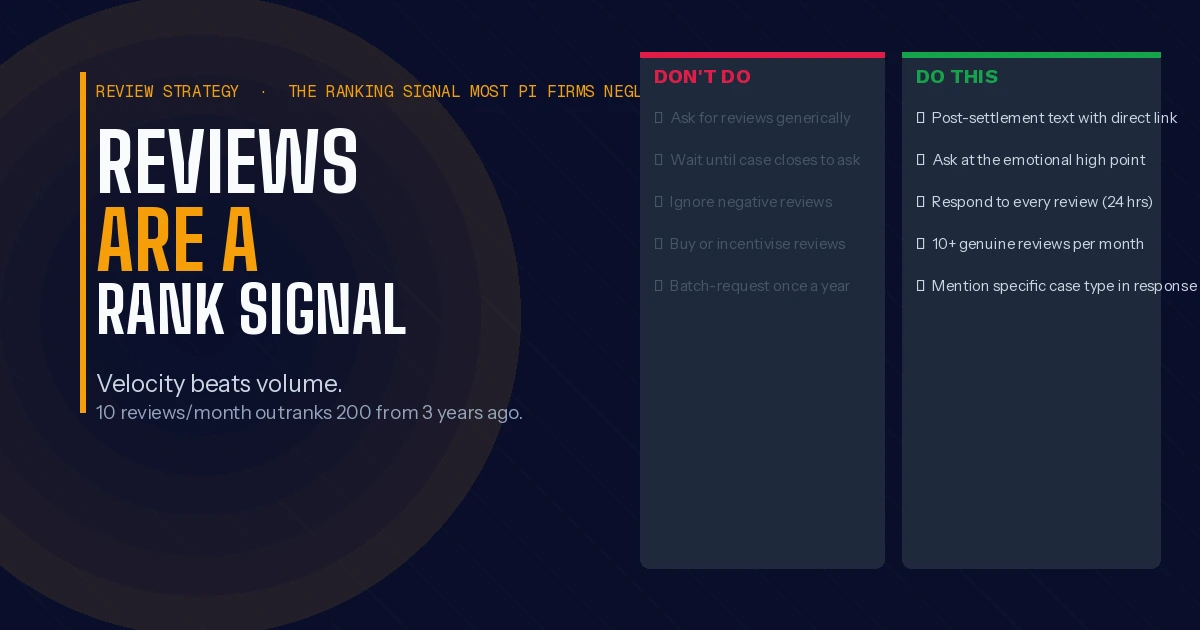
Ten genuine reviews posted in the past month will consistently outperform 200 reviews posted over three years for local 3-pack ranking purposes. Google’s local algorithm interprets review recency as a proxy for current client satisfaction and business activity. A stale review profile — regardless of its total volume — signals a firm that is no longer actively seeking or receiving client feedback. Building a systematic review process is therefore one of the highest-ROI GBP improvements available to most law firms.
When to ask
The optimal review request moment for law firms is at case resolution — specifically within 24 hours of settlement payment, verdict delivery, or case close. This is the emotional high point: the client has received their outcome, gratitude is at its peak, and the connection to the attorney is strongest. Requests sent at this moment convert at 3–4× the rate of requests sent during the case or weeks after resolution.
The delivery method matters significantly. Text message review requests for legal clients convert at 4–5× the rate of email requests — text open rates for this request type typically exceed 90%, versus 20–30% for email. The message should be brief, personal, and include a direct link to the Google review page (not a landing page that requires the client to navigate): “Hi [name], it was a privilege helping you through your [case type]. If you’re willing to share your experience, it genuinely helps other people in similar situations find us: [direct link].”
How to respond to reviews
Respond to every review — positive and negative — within 24 hours. Response rate is itself a local ranking signal: it demonstrates that the GBP profile is actively monitored and that the business is engaged with its clients. For positive reviews, a brief, specific response that references the case type (without identifying details) performs better than a generic “thank you.” For negative reviews, respond calmly and professionally, acknowledge the feedback without admitting liability, and offer to discuss the matter offline. Never argue with a negative review publicly — it creates a negative engagement signal that suppresses local rankings and deters prospective clients reading the exchange.
NAP Consistency and Legal Directory Citations
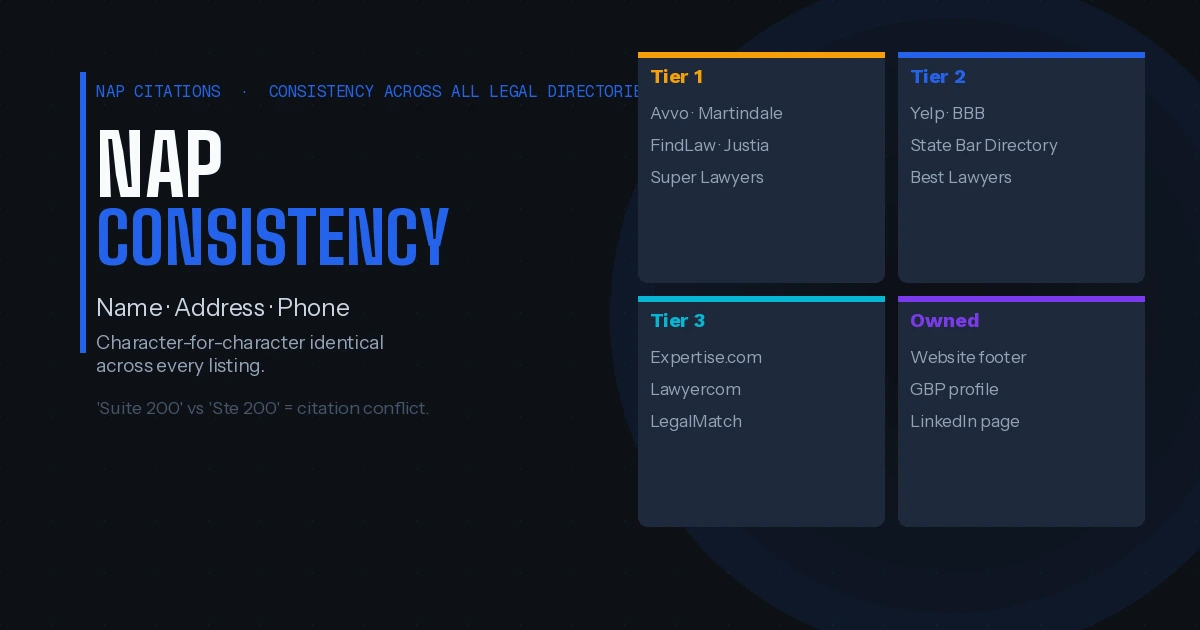
Name, Address, and Phone number must be character-for-character identical across every online listing where your firm appears. This means the firm name (including whether “LLC,” “LLP,” or “& Associates” is present), the street address (including whether “Street” is written out or abbreviated as “St.”), and the phone number (including whether the area code is formatted with parentheses or hyphens) must match exactly across GBP, your website, and every directory listing. A single inconsistency creates a citation conflict — Google’s local algorithm interprets NAP inconsistencies as evidence of business instability or inaccurate information, and suppresses the local ranking of profiles with citation conflicts.
Priority citation sources for law firms
Tier 1 — Complete and verify first: Avvo, Martindale-Hubbell, FindLaw, Justia, and Super Lawyers. These are the legal-specific directories with the highest authority signal for law firm GBP profiles. Each should have a complete firm profile (not just a name and address — include practice areas, attorney bios, and a website link) with NAP matching your GBP exactly.
Tier 2 — Complete after Tier 1: Yelp Business, Better Business Bureau, your state bar association’s attorney directory, and Best Lawyers. The state bar directory is particularly important because it is an authoritative, government-verified source — a citation from it carries outsized authority signal for law firm profiles.
Tier 3 — Supplement after Tier 1–2: Expertise.com, Lawyers.com, LegalMatch, and any local business directories that cover your city or region. These contribute to citation volume but carry less individual weight than Tier 1–2 sources.
Auditing existing citations
Use BrightLocal, Whitespark, or Moz Local to audit your existing citation profile — these tools scan the major citation sources and flag inconsistencies. Run this audit before adding new citations; adding correct citations while existing incorrect citations remain creates a conflicting citation set that is worse than no citations at all. Fix inconsistencies in your Tier 1 sources first, then expand.
GBP Posts and Q&A: The Activity Signals Google Weighs
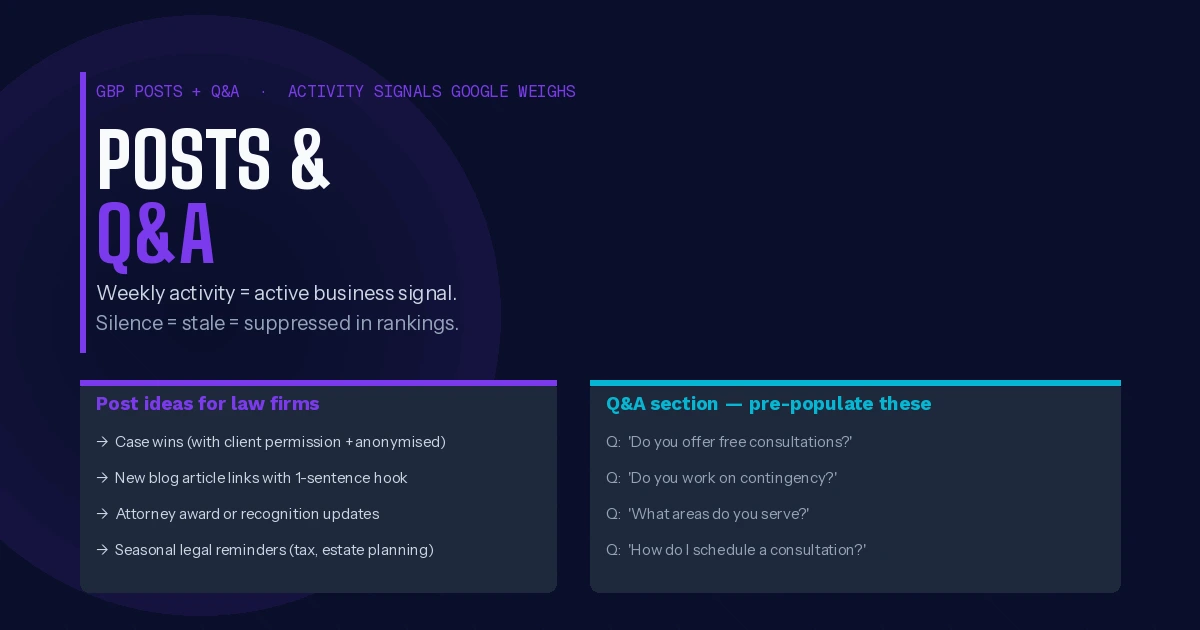
Regular GBP posts and an actively managed Q&A section signal to Google that your profile is current, monitored, and actively maintained — which correlates with 3-pack ranking performance. These are low-effort, high-signal activities that the majority of competing law firms neglect, which makes consistent execution of them a genuine competitive advantage rather than table stakes.
GBP posts: what to post and how often
Post to GBP at minimum once per week. Posts don’t need to be long — 100–150 words with a relevant image and a link is sufficient to maintain the activity signal. The best-performing post types for law firms: recent blog articles (headline + two-sentence hook + link), case win announcements (anonymised, with case type and outcome), attorney recognitions or award announcements, and seasonal legal reminders relevant to your practice area (estate planning reminders before the end of the tax year, accident rate reminders around major holidays for PI firms). Avoid pure promotional posts (“Call us today for a free consultation!”) — they receive lower engagement and don’t provide information value to users reading your GBP profile.
Q&A section: pre-populate before someone else does
The GBP Q&A section is a public forum — anyone can ask a question, and anyone can answer it. If your firm doesn’t pre-populate the Q&A section with your own questions and answers, you risk having questions answered incorrectly by random users, or having your GBP profile appear sparse and unmaintained. Pre-populate with five to eight questions that directly address the highest-frequency pre-hire concerns for your practice area: “Do you offer free consultations?” “Do you handle cases on contingency?” “What areas do you serve?” “How do I schedule a consultation?” “How long will my case take?” Answer each question as the business owner, specifically and directly. Respond to any new questions within 24 hours.
Multi-Location Law Firms: One GBP Per Office
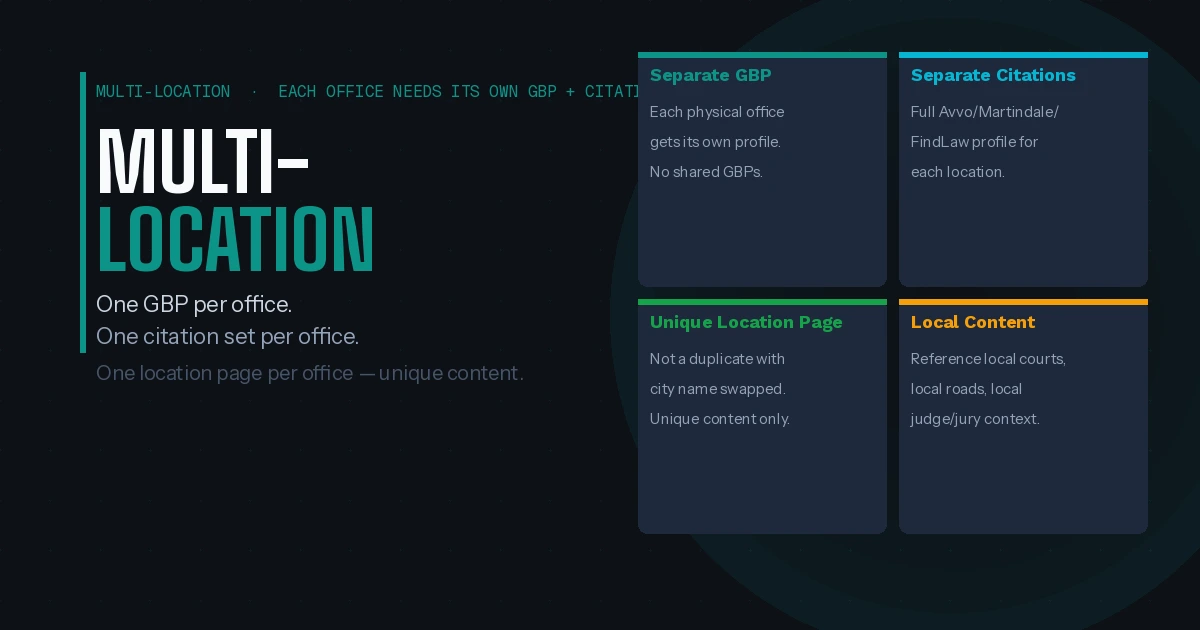
Every physical office location requires its own GBP profile, its own complete citation set, and its own location page on the firm’s website with unique content. A multi-location firm that manages all locations under a single GBP profile, or that uses duplicate website pages with only the city name changed, will rank for none of its target markets effectively — because Google cannot determine which location is relevant for a given geographic query.
Setting up multiple GBP profiles correctly
Each location’s GBP profile must use the exact physical address of that office (not a centralised billing address or a virtual office shared with other businesses), the direct phone number for that office, the hours specific to that location, and photos of that specific office. The firm name should be consistent across locations, but Google allows location identifiers in parentheses: “Johnson & Associates (Chicago)” and “Johnson & Associates (Oak Park)” are acceptable variations that help users identify the specific location while maintaining brand consistency.
Location pages: unique content, not duplicate with city swap
Each office location needs a unique website page that serves as the landing page linked from that location’s GBP profile. Unique content means: specific references to the local courts the attorneys practice in (“We handle cases in Cook County Circuit Court and the Northern District of Illinois”), local transportation or neighbourhood context, the specific attorneys based at that location, and any practice areas that differ between offices. A location page that is identical to another location page with only the city name changed is a thin duplicate content signal — Google’s Panda-era duplicate content evaluation still applies, and duplicate location pages consistently underperform unique ones for local pack correlation.
The GBP Audit Checklist for Law Firms
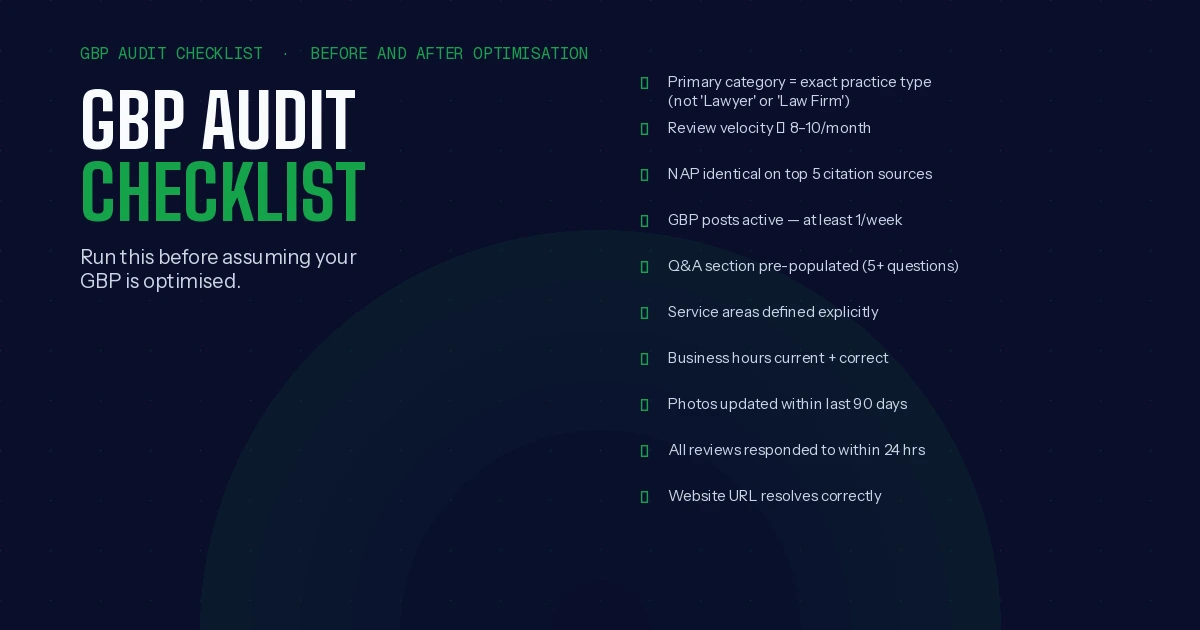
Run this checklist on any existing GBP profile before assuming it is optimised. Each item that fails represents a specific ranking suppression factor that, once corrected, will typically produce measurable 3-pack movement within 30–60 days.
GBP audit checklist — law firms:
- Primary category = exact practice type (not “Lawyer” or “Law Firm”)
- Secondary categories cover all active practice areas
- Review velocity ≥ 8–10 genuine reviews per month
- All reviews responded to within 24 hours
- NAP identical across GBP, website footer, Avvo, Martindale, FindLaw, and state bar directory
- GBP posts active — minimum 1 per week for the past 8 weeks
- Q&A section pre-populated with 5+ firm-answered questions
- Service areas defined explicitly in the GBP Service Areas tab
- Business hours current and accurate (including holiday hours)
- Photos updated within the past 90 days (interior, exterior, team)
- Website URL in GBP resolves correctly and loads under 3 seconds on mobile
- GBP description uses practice-area keywords naturally (no keyword stuffing)
Any item on this checklist that is currently failing is a tractable ranking improvement — none of these require technical SEO work, backlink acquisition, or content production. They are operational improvements that most firms leave undone because no one owns the GBP maintenance task. Assigning GBP maintenance to a specific team member with a weekly checklist is often the single highest-ROI hour in a law firm’s marketing operations.
Frequently Asked Questions About Google Business Profile for Law Firms
How often should a law firm post on Google Business Profile?
Minimum once per week to maintain the activity signal that correlates with 3-pack ranking performance. Two to three posts per week is optimal for competitive markets. Posts should provide information value — a blog article link, a case type announcement, or a legal reminder — not just promotional calls to action. Consistency matters more than frequency: five posts in one week followed by a three-week silence performs worse than one post every week sustained over three months.
Does Google Business Profile affect organic search rankings?
GBP signals — review velocity, category selection, NAP consistency, post activity — primarily affect local 3-pack rankings, which are a separate algorithmic system from organic search rankings. However, there is evidence of correlation between strong GBP performance and organic ranking improvements for local queries, likely because a well-maintained GBP profile contributes to the overall prominence signals that Google uses for both local and organic evaluation. Treat them as complementary systems that reinforce each other rather than alternatives.
What should a law firm do about fake or negative reviews?
For fake reviews that you can demonstrate are not from genuine clients (reviews from accounts with no history, reviews from accounts that reviewed dozens of businesses in a single day, or reviews that describe a case your firm has no record of), flag them for removal through the GBP dashboard. Google’s review removal process requires clear evidence — document your case before submitting. For genuine negative reviews, respond professionally within 24 hours, acknowledge the feedback without admitting liability, and offer to discuss offline. Never attempt to bury negative reviews by generating a sudden spike in positive reviews — the velocity anomaly is detectable and can result in review removal.
How long does GBP optimisation take to affect local pack rankings?
Category corrections and citation cleanup typically produce visible 3-pack movement within 30–60 days. Review velocity improvements take 60–90 days to reflect meaningfully, because the algorithm evaluates recency over a rolling window rather than counting total reviews. Post and Q&A activity signals accumulate over 4–8 weeks of consistent maintenance. Firms that implement all optimisations simultaneously — category, citations, review system, posts — typically see the most significant 3-pack movement at the 60–90 day mark.
Can a law firm appear in multiple cities’ local 3-packs?
A single GBP profile can appear in 3-pack results for queries within a defined service area radius, but the strongest 3-pack positions are consistently held by firms with a physical office in or immediately adjacent to the queried city. For a firm that serves multiple cities without offices in each, the most effective approach is to define service areas in the GBP Service Areas tab (which expands 3-pack eligibility for surrounding areas) and ensure that the website has unique location pages for each target city. This will produce lower 3-pack positions than a physical office would, but is the correct strategy for service-area-based legal practices.
Does the number of GBP photos affect local rankings?
Photo quantity and recency are minor positive signals in GBP ranking algorithms — they contribute to the “completeness” of the profile, which is itself a ranking factor. More importantly, profiles with recent, professional photos (interior, team, and exterior shots updated within 90 days) convert at higher rates from 3-pack clicks to website visits and phone calls, because photos reduce uncertainty for potential clients evaluating multiple firms. The ranking impact is modest; the conversion impact is more significant. Prioritise photo quality and recency over volume.
GBP Is the Fastest Lever in Law Firm Local SEO
GBP optimisation has a faster feedback loop than any other component of law firm SEO. Organic rankings take months to move. GBP improvements — category correction, citation cleanup, review velocity, post consistency — begin showing ranking impact within 30–90 days. For firms that want visible results quickly while the broader SEO program matures, GBP is where to start.
The checklist in Section 7 contains twelve items. Most law firms fail at least four of them. Each failure is a specific, fixable ranking suppression factor. Fixing them is an operational task, not a technical one — it requires time and discipline, not specialist expertise. The firms that maintain these twelve items consistently, month over month, hold 3-pack positions that their competitors can’t displace without matching the same operational discipline.
Want a GBP audit for your law firm?
Harmukh Technologies runs GBP audits for law firms that identify every suppressible factor in your current profile, benchmark your review velocity and citation consistency against your top 3-pack competitors, and deliver a prioritised action plan with clear timelines.